
What is the volume of the cylinder shown? Prepare to embark on an exhilarating journey into the realm of three-dimensional shapes! We’re diving headfirst into the fascinating world of cylinders, those ubiquitous geometric marvels that grace our everyday lives. From towering water tanks to petite soda cans, understanding cylinder volume is key to unlocking a wealth of practical applications and mathematical insights.
Get ready to explore the fundamental principles, master the formulas, and solve real-world problems with confidence and flair!
We’ll start with the basics, understanding what a cylinder
-is*, breaking down its components like the base, height, and radius. We’ll then unravel the concept of volume itself, learn the standard units of measurement, and see how volume differs from related concepts like surface area. You’ll become a master of the volume formula, learning how to apply it with precision and accuracy.
Furthermore, we’ll equip you with the skills to identify cylinder dimensions, even in tricky scenarios. Finally, we’ll delve into the practical applications of cylinder volume, from calculating the capacity of containers to solving captivating problem sets, all presented with engaging explanations and examples!
Understanding the Basics of a Cylinder

The concept of a cylinder is fundamental in geometry and finds extensive applications in various fields, from engineering and architecture to everyday objects. Understanding its definition and components is crucial for calculating its volume and exploring its properties. This section will delve into the essential aspects of a cylinder, providing a clear and concise overview.
Geometric Definition of a Cylinder
A cylinder is a three-dimensional geometric shape that is formed by the set of all points that are a fixed distance from a straight line called the axis. This definition emphasizes the core characteristic: a cylinder is essentially a surface generated by a line moving parallel to a fixed line (the axis) and always intersecting a closed curve (the base).
The most common type of cylinder is a right circular cylinder, where the axis is perpendicular to the circular bases.
Components of a Cylinder
The components of a cylinder are essential to understanding its structure and calculating its volume.
- Base: The base of a standard cylinder is a circular surface. Cylinders typically have two bases, congruent to each other, located at opposite ends of the cylinder.
- Height: The height of a cylinder is the perpendicular distance between the two bases. It represents the length of the cylinder along its axis.
- Radius: The radius is the distance from the center of the circular base to any point on its circumference. The radius is a crucial parameter used in volume calculations.
Visual Representation of a Cylinder
Consider a right circular cylinder, a commonly observed type.
A cylinder is depicted as a three-dimensional shape. Two parallel circles are positioned, one at the top and one at the bottom, representing the bases. A curved surface connects the circumferences of these two circles. A line is drawn vertically, connecting the center of the top circle to the center of the bottom circle; this is the height. A line segment extending from the center of either circle to the edge of the circle represents the radius.
The diagram clarifies the relationship between the base, height, and radius, providing a visual understanding of the cylinder’s structure. The bases are clearly circular, and the height is represented by a line segment perpendicular to the bases. The radius is illustrated as a line segment originating from the center of each circular base to its circumference.
Defining Volume

Volume, a fundamental concept in geometry, quantifies the three-dimensional space enclosed by a closed surface. It’s a crucial measurement for understanding the capacity of objects, from everyday items like water bottles to complex structures like buildings. This section delves into the specifics of volume, differentiating it from related concepts and clarifying its measurement units.
The Essence of Volume in Three Dimensions
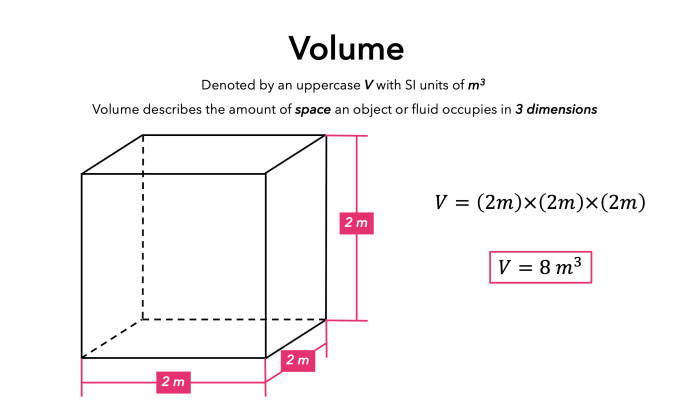
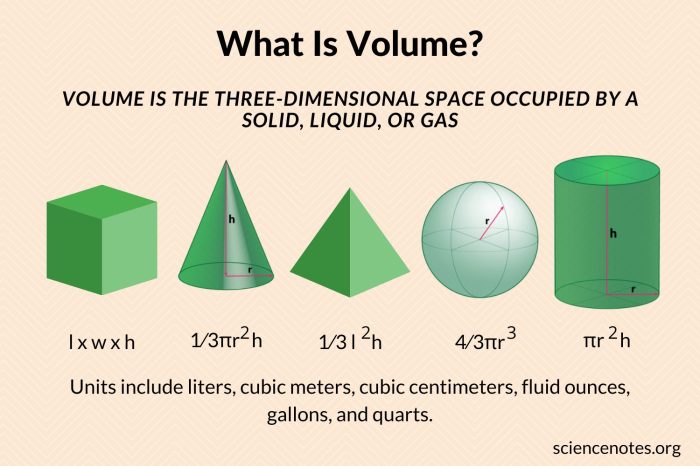
Volume represents the amount of space an object occupies. Unlike area, which measures a two-dimensional surface, volume considers the depth or height, giving a three-dimensional perspective. This distinction is critical for understanding the properties of solid objects. Imagine filling a container: the volume represents the total amount of substance that can be contained within it. This concept applies to regular shapes, like cubes and spheres, and irregular shapes.
Units of Measurement for Volume
The standard unit for measuring volume is the cubic meter (m³), defined as the volume of a cube with sides one meter long. However, various units are used depending on the scale and context. Smaller volumes are often measured in cubic centimeters (cm³), where 1 cm³ equals the volume of a cube with sides one centimeter long. For liquids, liters (L) are commonly used, with 1 liter equivalent to 1000 cm³ or 0.001 m³.
Other units include cubic inches (in³), cubic feet (ft³), and gallons (gal), each defined relative to their respective length units.To illustrate, consider the following examples:
- A small sugar cube might have a volume of approximately 1 cm³.
- A standard bathtub can hold around 0.2 m³ (or 200 liters) of water.
- A large shipping container could have a volume of 70 m³.
Differentiating Volume from Surface Area
Volume and surface area are related but distinct concepts. Surface area measures the total area of the exterior surfaces of an object, essentially the amount of material needed to cover it. Volume, as previously explained, measures the space the object occupies. A simple analogy:
- Imagine wrapping a gift. The wrapping paper used represents the surface area.
- The space inside the wrapped box, where the gift is placed, represents the volume.
Consider a cube with sides of length
s*. Its volume (V) is calculated as
V = s³
Its surface area (SA) is calculated as:
SA = 6s²
Notice that the units are different. Volume is measured in cubic units (e.g., cm³), while surface area is measured in square units (e.g., cm²). These distinct measurements provide different insights into the properties of an object.
The Formula for Cylinder Volume
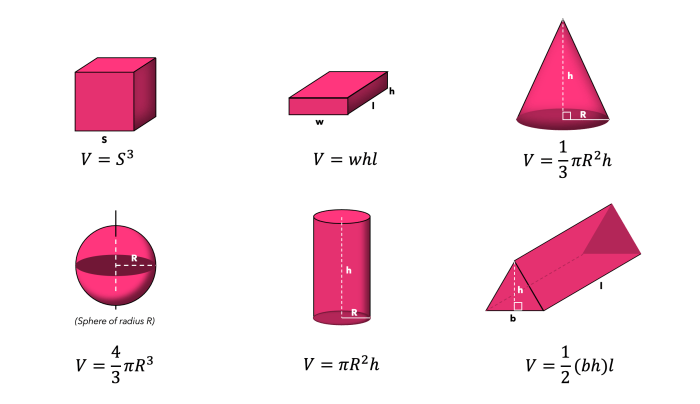
Understanding the volume of a cylinder requires a precise method for calculation. This involves a straightforward formula that leverages fundamental geometric principles. The formula, when applied correctly, provides an accurate measure of the three-dimensional space enclosed by the cylinder. This is essential for various applications, from engineering to everyday tasks.
The Formula Explained
The formula for calculating the volume of a cylinder is based on its fundamental geometric properties: the radius of its circular base and its height. The volume represents the total space the cylinder occupies.The formula is:
V = πr²h
Where:
- V represents the volume of the cylinder, typically measured in cubic units (e.g., cubic centimeters, cubic meters).
- π (pi) is a mathematical constant, approximately equal to 3.14159. It represents the ratio of a circle’s circumference to its diameter.
- r represents the radius of the circular base of the cylinder. The radius is the distance from the center of the circle to any point on its circumference, measured in linear units (e.g., centimeters, meters).
- h represents the height of the cylinder. The height is the perpendicular distance between the two circular bases, also measured in linear units.
To illustrate how to use the formula, let’s consider a practical example.Assume a cylinder has a radius (r) of 5 cm and a height (h) of 10 cm. To calculate the volume (V):
1. Square the radius
r² = 5 cm5 cm = 25 cm².
2. Multiply the squared radius by π
25 cm²
- 3.14159 ≈ 78.54 cm².
- 10 cm ≈ 785.4 cm³.
3. Multiply the result by the height
78.54 cm²
Therefore, the volume of the cylinder is approximately 785.4 cubic centimeters. This calculation is a fundamental skill in various fields, demonstrating the practical application of the formula. This method can be applied to diverse scenarios, from determining the capacity of a water tank to calculating the amount of material needed for construction projects.
Identifying Cylinder Dimensions: What Is The Volume Of The Cylinder Shown
Understanding the dimensions of a cylinder is crucial for accurately calculating its volume. This involves determining the radius and height. The methods for identifying these dimensions vary depending on the cylinder’s characteristics and orientation, including whether it’s partially filled or positioned in an unusual way. Careful and precise measurements are paramount for reliable volume calculations.
Identifying the Radius of a Cylinder
The radius, the distance from the center of the circular base to its edge, is a fundamental dimension. Measuring the radius requires understanding the cylinder’s base.The following techniques can be used to determine the radius:
- Direct Measurement: If the base is easily accessible, use a ruler or caliper. Place the measuring tool across the diameter (the distance across the circle through its center) and divide the result by two to obtain the radius. This method is straightforward for cylinders with accessible, flat bases. For instance, consider a standard cylindrical can. Using a ruler, measure the diameter of the circular base.
If the diameter is 8 cm, the radius is 4 cm.
- Circumference Measurement: If direct measurement is difficult or impossible, the circumference (the distance around the circle) can be measured. Then, the radius can be calculated using the formula:
Radius = Circumference / (2
– π)For example, if the circumference of a cylinder’s base is measured as 31.4 cm, the radius would be approximately 31.4 cm / (2
– 3.14159) = 5 cm. This method is useful when the base is obstructed. - Indirect Measurement (for irregularly shaped or inaccessible bases): In situations where direct measurement is challenging, indirect methods are employed. This could involve using a string or flexible measuring tape to measure the circumference and then applying the formula above. Consider a large, partially buried cylindrical tank. Measuring the diameter directly is difficult, but the circumference can be measured around the visible portion.
Methods for Measuring the Height of a Cylinder
The height, the perpendicular distance between the two bases, is the second critical dimension. Accurate height measurement is essential for volume calculation.The following approaches can be utilized for measuring the height:
- Direct Measurement: For cylinders with accessible bases and a straight side, a ruler or measuring tape can be used. Position the measuring tool along the cylinder’s side, ensuring it’s perpendicular to the base, to measure the height. For example, to measure the height of a water bottle, you would simply measure from the bottom to the top.
- Using a Level and Ruler (for tilted cylinders): When the cylinder is tilted, a level is required to ensure the measurement is perpendicular to the base. Place the level against the cylinder to ensure the ruler is aligned vertically. Measure the distance from the bottom to the top along the level. For instance, if measuring a partially submerged cylindrical container, ensure the measurement is perpendicular to the water surface, which represents the base.
- Indirect Measurement (for large or inaccessible cylinders): In cases where direct measurement is impractical, such as for very large tanks, indirect methods may be necessary. This could involve using laser rangefinders or other specialized equipment. Laser rangefinders can measure the distance to the top and bottom of the cylinder, allowing for the height to be determined. Consider a large oil storage tank; direct measurement may be dangerous or impossible, so a laser rangefinder provides a safer and more practical solution.
Techniques for Cylinders in Unusual Orientations
Cylinders may be encountered in various orientations, including partially filled or positioned at angles. Adaptations to measurement techniques are needed in these scenarios.
- Partially Filled Cylinders: The volume of a partially filled cylinder can be determined by measuring the height of the filled portion and applying the cylinder volume formula to that portion. For instance, a cylinder filled to half its height will have a volume equal to half the total cylinder volume. This is applicable when dealing with liquids or other substances inside the cylinder.
- Cylinders at an Angle: If a cylinder is tilted, the height measurement must be adjusted to ensure it’s perpendicular to the base. The base is the circular end. Use a level to ensure the measurement is taken at a 90-degree angle. This ensures the height measurement accurately reflects the perpendicular distance, critical for volume calculations.
- Irregular Cylinder Shapes: If the cylinder has unusual features, such as indentations or bulges, it’s essential to carefully measure the dimensions and consider how these features impact the volume. The standard volume formula might not be directly applicable, and more complex calculations or estimations may be required. For instance, if a cylinder has a slightly irregular shape due to manufacturing, the measurements need to consider the average diameter and height to get a reasonable estimate of the volume.
Calculating Volume with Different Units

The ability to calculate cylinder volume is significantly enhanced when one can seamlessly work with various units of measurement. Real-world applications often present scenarios where dimensions are given in different units, necessitating conversion to maintain accuracy and consistency. Understanding and applying these conversions is crucial for solving practical problems, from engineering projects to everyday tasks like calculating the capacity of a container.
Converting Between Units of Volume
Converting between units of volume requires understanding the relationship between the units and applying the appropriate conversion factors. These factors are derived from the relationships between the base units of length, area, and volume. For instance, converting between cubic inches and cubic centimeters involves using the conversion factor based on the relationship between inches and centimeters.To convert between different units of volume, it’s essential to:
- Identify the initial unit of volume and the target unit.
- Determine the conversion factor that relates the two units. This factor is often expressed as a ratio.
- Multiply the initial volume by the conversion factor. The units in the initial volume should cancel out, leaving the target unit.
For example, to convert 100 cubic inches to cubic centimeters, you would multiply 100 by the conversion factor (1 cubic inch = 16.3871 cubic centimeters). This would result in approximately 1638.71 cubic centimeters.
Examples of Volume Calculation with Mixed Units
Calculating the volume of a cylinder when the radius and height are given in different units requires careful attention to unit conversion. This ensures that all dimensions are expressed in the same unit before applying the volume formula.Consider a cylinder with a radius of 5 inches and a height of 10 centimeters. To calculate the volume, one of the dimensions needs to be converted.
Let’s convert the radius from inches to centimeters using the conversion factor (1 inch = 2.54 centimeters). The radius becomes 5 inches
2.54 cm/inch = 12.7 centimeters. Now, the volume can be calculated using the formula
Volume = π
- radius2
- height
Plugging in the values:
Volume = π
- (12.7 cm)2
- 10 cm ≈ 5092.83 cm 3
Alternatively, the height can be converted from centimeters to inches. Using the conversion factor (1 cm = 0.3937 inches), the height becomes 10 cm
0.3937 inch/cm = 3.937 inches. The volume then becomes
Volume = π
- (5 inches)2
- 3.937 inches ≈ 309.28 inches 3
Both calculations provide the correct volume, but the units are different. Therefore, understanding unit conversion is crucial for consistent and accurate results.
Unit Conversion Table for Volume
A readily available reference table can be invaluable for quickly converting between various units of volume. This table provides the conversion factors, allowing for efficient and accurate calculations.Here is a table illustrating unit conversions for volume:
| Unit 1 | Unit 2 | Conversion Factor |
|---|---|---|
| Cubic Inches (in3) | Cubic Centimeters (cm3) | 1 in3 = 16.3871 cm3 |
| Cubic Feet (ft3) | Cubic Meters (m3) | 1 ft3 = 0.0283168 m3 |
| Cubic Yards (yd3) | Cubic Meters (m3) | 1 yd3 = 0.764555 m3 |
| Gallons (US liquid) | Liters (L) | 1 gal = 3.78541 L |
| Liters (L) | Cubic Centimeters (cm3) | 1 L = 1000 cm3 |
Practical Applications of Cylinder Volume
Understanding cylinder volume is not just an academic exercise; it’s a fundamental skill with broad applications in numerous fields and everyday scenarios. From engineering and manufacturing to cooking and environmental science, the ability to calculate cylinder volume is essential for solving practical problems, optimizing designs, and making informed decisions. This section will explore some key applications and provide practical examples to illustrate the importance of this calculation.
Real-World Examples of Cylinder Volume Importance
Calculating the volume of a cylinder is crucial in various real-world scenarios. It allows for accurate estimations and effective management of resources.
- Calculating Tank Capacity: One of the most common applications is determining the capacity of cylindrical tanks used for storing liquids or gases. This includes everything from water tanks in homes to fuel tanks in vehicles and industrial storage containers. Understanding the volume allows for proper sizing, efficient utilization, and safe operation. For example, a water storage tank is cylindrical, and knowing its volume helps determine how much water it can hold, influencing water supply planning for a household or community.
- Manufacturing and Production: In manufacturing, cylinder volume calculations are essential for designing and producing cylindrical components like pipes, tubes, and containers. Manufacturers use volume calculations to determine material requirements, optimize production processes, and ensure product specifications are met. Consider the production of soda cans; knowing the volume is essential for ensuring the correct amount of liquid is filled into each can.
- Construction and Engineering: Engineers utilize cylinder volume calculations when designing structures like silos, columns, and pipes. It helps them determine the amount of material needed, assess structural integrity, and ensure the efficient flow of fluids or solids. For instance, when constructing a concrete column, engineers need to calculate the volume of concrete required to fill the cylindrical form.
- Environmental Science: In environmental applications, cylinder volume is used to estimate the capacity of containment vessels, analyze the volume of water in cylindrical reservoirs, and assess the storage capacity of waste containers. It plays a role in managing waste and monitoring environmental impacts. Consider a scenario where a cylindrical oil drum leaks; calculating its volume helps determine the amount of oil spilled.
- Cooking and Baking: While less scientific, cylinder volume calculations can be useful in the kitchen. Measuring the volume of ingredients, such as flour or liquids, when using cylindrical measuring cups or containers, is essential for accurate recipes. Knowing the volume of a cake pan helps to determine the appropriate amount of batter.
Scenarios for Cylinder Volume Calculations
Cylinder volume calculations are applicable across various fields, enabling solutions to practical challenges.
- Scenario 1: Fuel Tank Capacity: A cylindrical fuel tank on a truck has a radius of 0.75 meters and a height of 3 meters. What is the maximum volume of fuel the tank can hold? This calculation helps determine the truck’s range and refueling needs. The volume can be found using the formula:
V = πr²h
where ‘r’ is the radius, and ‘h’ is the height.
- Scenario 2: Water Pipe Flow Rate: A cylindrical water pipe with a diameter of 0.2 meters is carrying water. If the water flows at a speed of 2 meters per second, what is the volume of water flowing through the pipe per second? This calculation helps engineers assess water flow rates and pipe capacity. First, calculate the cross-sectional area of the pipe, then multiply by the flow speed to find the volume per second.
- Scenario 3: Silo Storage: A cylindrical silo in a grain storage facility has a radius of 5 meters and a height of 20 meters. How many cubic meters of grain can the silo hold? This calculation helps in planning storage needs and managing inventory. Using the formula
V = πr²h
provides the silo’s total capacity.
- Scenario 4: Oil Drum Storage: An oil drum has a radius of 0.3 meters and a height of 1 meter. If the drum is filled to 80% capacity, what is the volume of oil stored? This is essential for inventory management and safety compliance. Calculate the full volume, then multiply by 0.8 to find the volume of oil.
- Scenario 5: Baking a Cake: A cylindrical cake pan has a diameter of 20 centimeters and a height of 7.5 centimeters. If the recipe calls for filling the pan ⅔ full with batter, what volume of batter is needed? This helps bakers measure the correct amount of batter for the cake. Calculate the full volume of the pan and multiply by ⅔ to find the volume of batter required.
Problem Set: Calculating Cylinder Volume
The following problems provide opportunities to practice cylinder volume calculations in diverse contexts.
- Problem 1: A cylindrical water tank has a radius of 2 meters and a height of 4 meters. What is the volume of the tank?
- Problem 2: A cylindrical pipe has a diameter of 10 cm and a length of 5 meters. Calculate the volume of the pipe. (Remember to convert units.)
- Problem 3: A cylindrical storage container in a warehouse has a radius of 3 feet and a height of 6 feet. If it is filled with a substance to 75% of its capacity, what volume is occupied?
- Problem 4: A cylindrical can of soup has a radius of 4 cm and a height of 12 cm. What is the volume of the soup the can can hold?
- Problem 5: A cylindrical well has a diameter of 1.5 meters and a depth of 10 meters. What is the volume of water the well can hold?
Visualizing Cylinder Volume

Understanding the volume of a cylinder goes beyond just applying a formula. It involves developing a strong intuitive grasp of how much space a cylinder occupies. One effective way to build this understanding is through visualization, and a classic method involves water displacement.
Water Displacement Method for Visualization
The water displacement method offers a hands-on approach to understanding cylinder volume. It relies on the principle that an object submerged in water displaces an amount of water equal to its own volume. This method provides a tangible way to connect the abstract concept of volume with a measurable physical quantity.The process of visualizing cylinder volume through water displacement involves several steps:
- Prepare the Setup: You’ll need a graduated cylinder or a container with clear volume markings, and water. Ensure the cylinder or container has markings to measure volume accurately. The cylinder should be large enough to accommodate the cylinder whose volume you are measuring.
- Initial Water Level: Carefully pour water into the graduated cylinder. Note and record the initial water level. This measurement represents the starting point.
- Submerge the Cylinder: Gently and completely submerge the cylinder whose volume you want to determine into the water. Ensure the cylinder is fully below the water’s surface. Avoid trapping air bubbles on the cylinder, as these will affect the accuracy of your measurement.
- Observe the New Water Level: After the cylinder is submerged, observe the new water level. The water level will have risen because the cylinder is taking up space, displacing some of the water.
- Calculate the Volume: Subtract the initial water level from the new water level. The difference between these two values represents the volume of the cylinder.
This method directly connects the physical space occupied by the cylinder with a measurable quantity of water. For example, if the initial water level was 50 ml, and after submerging the cylinder, the water level rose to 85 ml, the volume of the cylinder is 35 ml (85 ml – 50 ml = 35 ml). This visual and tactile experience reinforces the understanding of what volume truly represents.
Thought Experiment: Cylinder and Water
Consider a thought experiment to further solidify this concept. Imagine a perfectly cylindrical glass, and a large container filled with water. The glass is empty.First, imagine the cylindrical glass. It has a specific height and radius, and thus, a calculated volume. Now, visualize slowly lowering this empty glass into the water-filled container.As the glass enters the water, it pushes the water aside.
The water level in the container will rise. The amount the water level rises is directly proportional to the volume of the glass submerged in the water. If the glass is fully submerged, the total rise in the water level represents the total volume of the glass.This thought experiment demonstrates a crucial point: the volume of the glass, the space it occupies, directly correlates with the amount of water it displaces.
It highlights the principle of volume as the measure of the three-dimensional space an object occupies.
Variations in Cylinder Shapes

The fundamental volume formula for a cylinder, while seemingly straightforward, conceals a subtle adaptability. The formula’s core, based on the area of the base multiplied by the height, remains constant. However, the application of this formula requires a nuanced understanding of different cylinder types, particularly how their geometries influence the measurement of height and the interpretation of the base’s properties.
Understanding these variations is critical for accurate volume calculations across a diverse range of real-world applications.
Applying the Volume Formula to Different Cylinder Types
The formula for the volume of a cylinder,
V = πr²h
, where ‘r’ is the radius of the base and ‘h’ is the height, is universally applicable, but its interpretation changes depending on the cylinder’s shape. This requires careful consideration of how to determine the height and the base area.
- Right Circular Cylinder: This is the most common type. The base is a perfect circle, and the sides are perpendicular to the base. The height (‘h’) is the perpendicular distance between the two circular bases. Calculating the volume is a direct application of the formula. For example, consider a right circular cylinder with a radius of 5 cm and a height of 10 cm.
The volume would be calculated as:
V = π
– (5 cm)²
– 10 cm ≈ 785.4 cm³ - Oblique Cylinder: Unlike a right cylinder, an oblique cylinder has sides that are not perpendicular to the base. The height (‘h’) is the perpendicular distance between the bases, which is shorter than the slant height. To calculate the volume, you still use the formula
V = πr²h
, but you must measure the perpendicular height, not the length of the slanted side. Imagine an oblique cylinder with a radius of 5 cm and a perpendicular height of 10 cm, despite having a slant height of, say, 12 cm. The volume remains approximately 785.4 cm³. The slant height is irrelevant to the volume calculation.
- Truncated Cylinder: A truncated cylinder is formed when a portion of a cylinder is cut off by a plane that is not parallel to the base. Calculating its volume requires more complex methods. It’s often approached by calculating the average height of the truncated portion and then using that average in the standard volume formula. Alternatively, integration can be used for more precise calculations.
For instance, consider a truncated cylinder where the base radius is 5 cm, and the heights at opposite ends of the cut are 8 cm and 12 cm. The average height is 10 cm. The volume calculation would proceed similarly to the right cylinder, using the average height:
V ≈ π
– (5 cm)²
– 10 cm ≈ 785.4 cm³. This illustrates how even with a non-uniform shape, the basic volume concept is maintained.
- Elliptical Cylinder: This type of cylinder has an elliptical base. The volume formula becomes
V = πab
– h, where ‘a’ and ‘b’ are the semi-major and semi-minor axes of the ellipse, and ‘h’ is the height. The calculation adjusts to account for the elliptical base area instead of the circular base. If an elliptical cylinder has semi-major axis (a) of 6 cm, semi-minor axis (b) of 4 cm, and a height (h) of 10 cm, then the volume is approximately 754 cm³.
Estimating Cylinder Volume

In many real-world scenarios, obtaining precise measurements for a cylinder is impractical or impossible. Estimating the volume becomes a crucial skill, enabling us to make informed judgments and calculations without relying on exact data. This section explores various methods for approximating cylinder volume, providing practical examples and strategies for improving estimation accuracy.
Methods for Estimating Volume, What is the volume of the cylinder shown
When precise measurements are unavailable, various techniques can be employed to estimate the volume of a cylinder. These methods often rely on visual assessment, readily available information, and educated guesses.
- Visual Comparison: Comparing the cylinder to known objects with a familiar volume can provide a rough estimate. For example, if a cylindrical container appears to be about the same size as a standard water bottle (approximately 500 ml), its volume can be estimated accordingly.
- Using Known Ratios: In situations where the cylinder’s dimensions are unknown, utilizing known ratios or proportions can be helpful. If the height is a multiple of the diameter, or if you can estimate a relationship between them, you can approximate the volume using this relationship.
- Indirect Measurement: When direct measurement is challenging, indirect methods can be used. For instance, if you can measure the amount of liquid a cylinder holds, you can use that as an estimate of its volume.
Practical Scenarios for Volume Estimation
Estimating cylinder volume is a practical skill in various situations, from everyday tasks to professional applications.
- Estimating Liquid Capacity: Imagine estimating the amount of water a cylindrical well holds. Without precise measurements of the well’s diameter and depth, one could visually assess the well’s size, compare it to a known container (like a bucket), and estimate the volume.
- Assessing Storage Needs: When determining the storage capacity of a cylindrical tank, such as an oil drum, an estimate can be made. If the height and approximate diameter are known, the volume can be estimated to assess if it can hold a certain quantity of material.
- Construction and Design: In construction, estimating the volume of cylindrical components, such as pipes or columns, is crucial. This can be done by estimating dimensions based on blueprints or existing structures.
Strategies for Accurate Estimations
Several strategies can enhance the accuracy of cylinder volume estimations.
- Breaking Down the Cylinder: Imagine the cylinder is a stack of circular discs. By estimating the area of the circular base and the height separately, the volume calculation becomes simpler.
- Using Known Benchmarks: Employing readily available benchmarks helps in refining estimations. For example, knowing the volume of a common object, like a soda can, allows for comparisons to estimate the volume of larger cylinders.
- Considering Real-World Factors: In real-world applications, account for factors that might affect the volume, such as the thickness of the cylinder’s walls or any internal obstructions.
- Employing Formulas with Approximations: Even when precise measurements are unavailable, the volume formula can be used with estimated values.
V = πr²h
Where V is volume, π (pi) is approximately 3.14, r is the radius, and h is the height. Even using approximate values for r and h will provide a reasonable estimate.
Problem-Solving with Cylinder Volume

The ability to calculate cylinder volume is a practical skill applicable across numerous fields, from engineering and architecture to everyday tasks like understanding how much liquid a container can hold. Mastering problem-solving techniques related to cylinder volume involves not only understanding the formula but also being able to interpret word problems, identify the necessary information, and apply the formula correctly.
This section provides a series of problems, complete with solutions and explanations, to enhance understanding and build confidence in solving real-world volume-related challenges.
Determining the volume of the cylinder shown necessitates the application of the formula πr²h, where ‘r’ represents the radius and ‘h’ the height. However, issues such as brake failure can arise, and understanding the symptoms, such as those detailed in how can you tell if master cylinder is bad , is crucial for vehicle safety. Ultimately, calculating the cylinder’s volume is a straightforward geometric task, independent of potential mechanical problems.
Solving Problems with Cylinder Volume
Problem-solving in cylinder volume requires a systematic approach. It is essential to identify the radius (r) or diameter (d) and the height (h) of the cylinder, then use the appropriate formula. Here’s a set of example problems to illustrate this process:
Problem 1: A cylindrical water tank has a diameter of 6 meters and a height of 10 meters. What is the volume of the tank in cubic meters?
Solution:
Radius (r) = Diameter / 2 = 6 meters / 2 = 3 meters
Height (h) = 10 meters
Volume (V) = π
- r 2
- h
V = π
- (3 meters) 2
- 10 meters
V ≈ 3.14159
- 9 square meters
- 10 meters
V ≈ 282.74 cubic meters
Answer: The volume of the water tank is approximately 282.74 cubic meters.
Explanation: The problem provides the diameter, so we first calculate the radius. Then, using the height and the calculated radius, we apply the formula for cylinder volume.The result is expressed in cubic meters because volume is a three-dimensional measurement.
Problem 2: A can of soup has a radius of 4 cm and a height of 12 cm. If the soup is filled to 90% of the can’s capacity, what is the volume of the soup in cubic centimeters?
Solution:
Radius (r) = 4 cm
Height (h) = 12 cm
Volume (V) = π
- r 2
- h
V = π
- (4 cm) 2
- 12 cm
V ≈ 3.14159
- 16 square cm
- 12 cm
V ≈ 603.19 cubic cm
Soup volume = 90% of V
Soup volume ≈ 0.90603.19 cubic cm
Soup volume ≈ 542.87 cubic cm
Answer: The volume of the soup is approximately 542.87 cubic centimeters.
Explanation: First, the total volume of the can is calculated. Then, the problem states the soup only fills 90% of the can.Thus, the total volume is multiplied by 0.90 (90%) to find the volume of the soup.
Problem 3: A cylindrical oil drum has a volume of 1.5 cubic meters and a height of 1.2 meters. What is the radius of the oil drum?
Solution:
Volume (V) = 1.5 cubic meters
Height (h) = 1.2 meters
V = π
- r 2
- h
r 2 = V / (π – h)
r 2 = 1.5 cubic meters / (π – 1.2 meters)
r 2 ≈ 1.5 / (3.14159 – 1.2)
r 2 ≈ 0.398 square meters
r ≈ √0.398 square meters
r ≈ 0.63 meters
Answer: The radius of the oil drum is approximately 0.63 meters.Explanation: This problem requires rearranging the volume formula to solve for the radius. We divide the volume by the product of pi and the height, and then take the square root of the result to find the radius.
Problem 4: A cylindrical pipe has an internal diameter of 10 cm and a length of 5 meters. If the pipe is made of a material that is 1 cm thick, what is the volume of the material used to make the pipe?
Solution:
Inner radius (r i) = 10 cm / 2 = 5 cm = 0.05 meters
Outer radius (r o) = 5 cm + 1 cm = 6 cm = 0.06 meters
Length (h) = 5 meters
Volume of the material = Volume of outer cylinder – Volume of inner cylinder
V o = π
- r o2
- h
V o = π
- (0.06 m) 2
- 5 m
V o ≈ 3.14159
- 0.0036 square meters
- 5 meters
V o ≈ 0.0565 cubic meters
V i = π
- r i2
- h
V i = π
- (0.05 m) 2
- 5 m
V i ≈ 3.14159
- 0.0025 square meters
- 5 meters
V i ≈ 0.0393 cubic meters
Volume of the material = V o – V i
Volume of the material ≈ 0.0565 cubic meters – 0.0393 cubic meters
Volume of the material ≈ 0.0172 cubic meters
Answer: The volume of the material used is approximately 0.0172 cubic meters.Explanation: This problem involves finding the volume of the material, not just the inner or outer volume. First, calculate the volume of the outer cylinder, then the volume of the inner cylinder (which represents the empty space). The difference between the two volumes gives the volume of the material. The calculation involves converting centimeters to meters for consistency in units.
Last Point
And there you have it! We’ve journeyed from the fundamental definition of a cylinder to its diverse real-world applications. You’ve now mastered the art of calculating cylinder volume, equipped with the knowledge to conquer any cylindrical challenge. From converting units to estimating volumes and tackling complex word problems, you’re ready to apply your newfound expertise with confidence. So go forth and explore the exciting world of cylinders, armed with your understanding of volume, and let your curiosity guide you to new mathematical heights!
General Inquiries
What is a cylinder?
A cylinder is a three-dimensional geometric shape with two parallel circular bases connected by a curved surface. Think of a can of soup or a roll of paper towels!
What’s the difference between a right circular cylinder and an oblique cylinder?
A right circular cylinder has its circular bases directly above each other, forming a 90-degree angle with the curved surface. An oblique cylinder has its bases offset, tilting the cylinder to one side.
Why is knowing the volume of a cylinder useful?
Knowing the volume helps you determine the capacity of containers, calculate material quantities for construction, and solve various engineering and design problems.
How do I measure the radius of a cylinder?
You can measure the diameter of the circular base and divide it by two. Or, you can directly measure the radius using a ruler or calipers.
What if the cylinder isn’t perfectly round?
If the cylinder is not perfectly round, you can take multiple measurements of the diameter and average them to get a more accurate radius for volume calculation.


